
Before Deep Sky, deep work helped found a culture of innovation in Innisfail


Driving through central Alberta still offers that familiar prairie poetry — big skies stretched wide over aspen bluffs, wheat fields bending with the wind, canola glowing under long summer light. But in Innisfail, something else has taken root alongside the crops and rail lines: confidence.
The central Alberta community between Calgary and Edmonton had been hoping to bring the Energy Futures Lab Roadshow program to the region for some time, but they weren’t resting on their laurels. They’d already been seeking diversification opportunities and supporting and adopting clean energy initiatives like Elemental Energy’s 25 MW Innisfail Solar Farm north west of town, and having conversations with clean energy innovators looking for the right environment in which to site novel technologies in the province. And the town had released their municipal Community Economic Development Strategy, The Power of Place.
Right around the same time, the Lab made a deliberate shift in how we would deliver the Roadshow program for 2022-2023. Rather than working with several communities in a single season, we decided to pilot a deeper, year-long engagement with a single municipality to increase community-level impact. And the one that happened to perfectly fit the bill was the Town of Innisfail. It was an experiment grounded in a simple question: what type of impact can we have when a community is given time, space, and sustained support to explore its energy future together? It was an experiment that paid off in ways we could not have imagined.
Laying the Groundwork
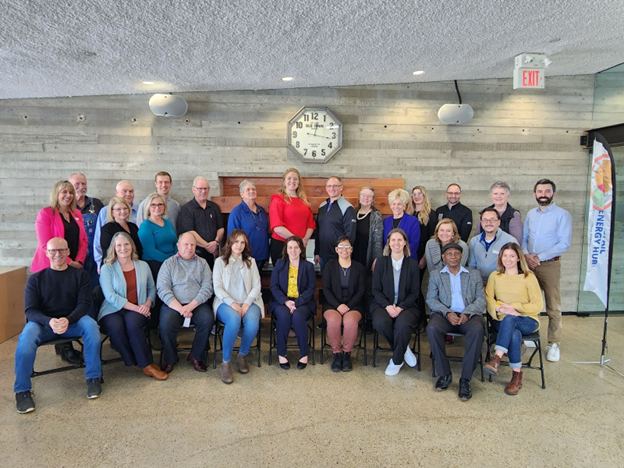
Over the course of a year, the Roadshow morphed from a series of in-person and online workshops to a shared process of sense-making that encompassed dedicated community conversations, formal learning journeys, and culminated in a set of community-led initiatives. It brought together Innisfail’s elected leaders, town administration, industry, high schoolers, and invested community members. This helped set a strong and shared foundation to develop a common vision for the region that would extend to how energy, economic development, and environmental stewardship could reinforce each other. As part of the process, the Lab team collaboratively helped to steward the creation of the Innisfail Energy Hub — a novel platform for dialogue, learning, and collaboration.

As Todd Becker, Chief Administrative Officer for the Town of Innisfail and an Energy Futures Lab Fellow, reflects, the value of the Roadshow went well beyond individual initiatives. “The Roadshow helped create the foundational piece — tying council’s vision to administration and giving us the confidence, literacy, and shared language to actually move ideas into action.”
That foundation proved to be a strong one. With a clear vision, supportive Council, and an empowered administration, Innisfail learned to move swiftly when opportunities emerged. The Roadshow created a forum where questions could be asked openly, concerns aired respectfully, and understanding could be built. This would prove useful as the town’s vision for a resilient and thriving energy future began to take shape.
When Opportunity Knocks
In the year following the Roadshow, that groundwork bore fruit. Innisfail announced it would be the home of Deep Sky, a first-of-its-kind direct air capture and carbon capture research, development, and testing facility. Designed as a ten-year project, Deep Sky is bringing global technologies to Alberta to compete, learn, and generate real-world performance data under Innisfail’s ideal, and picturesque, prairie skies.
For a small town in central Alberta, it was a major coup but it didn’t happen by accident. “All of the work leading up to Deep Sky mattered,” says Becker. “The Roadshow secured our philosophy and culture. It gave us the confidence to have real conversations with companies like Deep Sky — and they noticed.”
Deep Sky’s arrival was not without its challenges. Like many high-profile clean energy projects, there were moments of skepticism and pushback within the community. But thanks to the Roadshow and Energy Futures Lab’s model of harnessing tensions for generative conversation, Innisfail’s leadership had built the muscle to lean into those moments rather than shying away from them.
“It takes energy to talk about energy,” Becker says. “Deep Sky came with a rough couple of weeks, but it also came with a lot of support. Council didn’t shy away from the conversation. We weathered it.”

That willingness to host difficult conversations with transparency and respect proved critical. The same openness that characterized the Town’s participation in the Roadshow shaped how the Town engaged with Deep Sky: quickly, collaboratively, and with a clear sense of shared purpose. “We’re quick, we’re nimble, and we’re open,” Becker explains. “Our approach is: how do we get to yes?”
Signals of Change
The impact of the Town’s economic development strategy has extended well beyond a single project. Its presence has attracted interest from other clean technology companies, including those working in hydrogen, waste-to-energy, and related supply chains. With new investment has come both community growth and new pressures — including a housing shortfall driven by an influx of skilled workers and increased interest in living in a community seen as progressive, service-oriented, and future-facing.
“The label on our community has changed,” Becker reflects. “People want to live somewhere modern where leadership cares about economic opportunity and environmental stewardship.”
That leadership has also been nationally recognized. Since the Roadshow, the Town of Innisfail has received two significant awards: the Invest Alberta Belt Buckle Award, connected to the Deep Sky project, and the 2025 CCUS Leader of the Year Award, presented by Carbon Capture Canada in recognition of Council’s leadership and the strength of administration. As Becker notes, “those awards are tied to the foundational work. The Roadshow and EFL need to take credit for that. The Mayor mentions the Energy Futures Lab in those speeches every time.”
Despite celebrated successes and best efforts, not every clean energy initiative has moved forward at the same pace. A planned 2 MW municipal solar project was paused due to unfavourable market conditions — a challenge shared by municipalities across Alberta. At the same time, residential solar uptake is increasing, reflected in a growing number of household permits. “We haven’t shied away from the technologies,” says Becker. “Leadership is about keeping sustainability on the agenda even when it’s hard.”
Carrying the Story Forward
In November 2025, Innisfail underwent a municipal election, bringing a mix of returning and new councilors to the table. Mayor Jean Barclay continues in her role, and Becker remains at the helm as CAO. New faces mean new conversations and a focus on sharing the backstory of how Innisfail arrived at this moment. “The magic is in the conversations,” Becker says. “When councils or staff change, that context can get lost. We don’t want this to evaporate.” And in thinking of why it feels important, Becker credits the Roadshow as crucial. “It focused us. It helped sculpt an environment where projects like Deep Sky could land, and where administration felt ready to have those conversations.”
For Innisfail, clean energy isn’t just an environmental imperative anymore, it's also a core economic strategy. It builds resilience, attracts investment, keeps the town competitive, and builds long-term confidence.
What began as a Roadshow pilot became proof that when communities are supported to build shared vision, they can move fast when opportunity knocks.
Innisfail is still writing its next chapter. The ground is fertile, the seeds have been planted, the roots are growing deep, and the confidence to keep growing is firmly in place.
Comments