top of page

News & Insights

Never miss a beat.

Filter items with label

Search by term

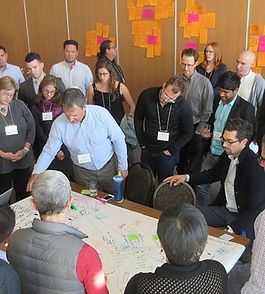
How do you accelerate innovation to an unnaturally high pace? According to Bill Gates, in a provocatively titled We Need an Energy Miracle piece last week from the Atlantic, society needs to ramp up innovation in order to accelerate “a transition to new forms of energy” and avoid running a global 3 or 4 degree climate experiment. His interview raised fascinating questions about the mechanics of how we might go about attempting to drive “innovation ‘at an unnaturally high pace.’” These are the exact questions that the organizers of the Energy Futures Lab (EFL) have been grappling with for the better part of two years as they prepared to launch an initiative aimed at “accelerating the transition to the energy system that the future requires.” “I suggest that you should set the bar at making history, and history’s waiting out there to be made. You are the right gang to do it.” – Avrim Lazar, former President and CEO of the Forest Products Association of Canada In contrast with Gates, the designers of the EFL don’t believe that we need a miracle, but rather a radically different approach to stimulating innovation through collaboration: a blend of state-of-the-art change lab methodology with leading edge public engagement strategies, and a planning framework to guide human action within planetary limits. With these tools, the right group of influencers may have a chance at cutting through the mind-numbing polarization that characterizes ‘debates’ over the future of energy in Alberta, and leverage the province’s energy resources and expertise to become a world leading energy system of the future. The core of the Energy Futures Lab process is the EFL Fellowship, and two weeks ago, all 40 of these leaders convened for the first time in Banff. The Fellows represent incredibly diverse interests from across the energy spectrum in Alberta, including oil and gas, provincial and local government, First Nations, and non-profits. Despite their differences, they all possess a proven leadership ability and deep desire to help shape the future of Alberta. Avrim Lazar, former President and CEO of the Forest Products Association of Canada and key architect of the landmark 2010 Boreal Forests Agreement, welcomed the Fellows to the launch by reminding them of exactly what they were there to do: “I suggest that you should set the bar at making history, and history’s waiting out there to be made. You are the right gang to do it.” — Over the course of the intensive three-day session that followed, the Fellows began to lay the groundwork for this ambitious undertaking. They took stock of one another’s experiences, expertise, and motivations, gave voice to common energy narratives at play throughout Alberta, and explored efforts already underway to transform how the province produces, distributes, and uses energy. The Fellows were guided through mapping exercises to reveal barriers to change and leverage points within the energy system where small interventions may result in wide-ranging effects, and had the opportunity to pitch initiatives to the group as projects for collaboration. Predictably, given the range of perspectives in the room, the Fellows did not always see eye to eye on either problems or solutions, but that friction, the organizers emphasize, is what will give the initiatives that emerge from the Lab a robustness that would otherwise be missing. There were disagreements, debates, and some uncomfortable discussions over the course of the session, but there was also common ground. The three day session in Banff was only the first of many meetings of the Fellows slated to take place over the next year but already a number of themes are becoming apparent. This is a community bent on making history. Just about the only thing the Fellows have 100% agreement on is that the EFL is not going to be another forum for great discussion. If this isn’t about doing, they’re not interested. Engaging the public is essential to success. If actions taken by the Fellows do not find fertile cultural ground, they’ll be doomed to fail. The EFL will need to frame initiatives that are compatible with the narratives being lived by Albertans, or find ways to shift those narratives. Sharing matters. The session opened with each Fellow presenting an object that symbolized commitment to the Lab. From family photos, to a 425 million year old fossil, to a Fellowship of the Rings DVD, what each brought said something authentic about themselves and was an investment of trust in the group. The value of the relationships forming out of this trust is difficult to quantify but absolutely essential to effective coordinated action. A number of questions and tensions are also emerging from the process. Fellows and Lab organizers have until January to ponder these before they meet again in Edmonton. How deeply does a group of actors need to understand the complexity of the Alberta energy system in order to identify high-leverage opportunities for change and effectively forecast barriers? Where do we draw the boundaries around our attempts to map such a complex system? To what extent must a group of collaborators share a common vision of success in order to effectively coordinate action?  Certainly, we can all agree that a future energy system must be sustainable, but how important is it that we all hold the same definition of sustainability? The possible rewards are vast, but the ambiguities of the Lab process can sometimes be frustrating for participants. How can we balance the desires of an action-oriented group, accustomed to pursuing specifically defined goals, with a process that, according to change lab guru Adam Kahane, is “emergent, unfolding, but almost never according to plan?” — In the coming months I’ll be following developments in the Energy Futures Lab, touching base with a number of the Fellows, and tracking EFL public engagement efforts. If the aim is history making, consider me a primary source chronicler with an inside track on events as they take shape. I am honoured and excited about the opportunity to play a role, however small, in the effort to accelerate innovation in Alberta an unnaturally high pace and I cannot wait to see how it turns out. #Culture_Shift #Fellowship #2015 #EFL_Vision #EFL_Platform

Recapping the First Energy Futures Lab Workshop

How do you accelerate innovation to an unnaturally high pace? According to Bill Gates, in a provocatively titled We Need an Energy Miracle piece last week from the Atlantic, society needs to ramp up innovation in order to accelerate “a transition to new forms of energy” and avoid running a global 3 or 4 degree climate experiment. His interview raised fascinating questions about the mechanics of how we might go about attempting to drive “innovation ‘at an unnaturally high pace.’” These are...
A blog from Energy Futures Lab Fellow Alex Nnamonu As Alberta begins grappling with the energy challenges of the 21st century, Alex Nnamonu, Executive Director of Major Legislative Project and Strategic Planning at Alberta Municipal Affairs is thinking beyond technology, beyond numbers… “A desirable future is one which is not dominated by “all-or-nothing” thinking, but one which delivers win-win outcomes. Energy Futures Lab is an opportunity, an unusual opportunity for people to start talking, start sharing information.” – Alex Nnamonu He’s thinking about soccer. Growing up in Nigeria, he recalls, “you play soccer in a little patch of ground and when you came back six months later, it was gone. There was a building there or a road there. The actual soccer field became some kind of gravel pit. For me one key parameter for responsible development is that it’s tied to what citizens feel, need and want. As a child, there was development happening, there was growth happening, but there was no longer a place to play soccer.” As a Fellow of the Energy Futures Lab, Nnamonu will join a lively and challenging new initiative that brings together leaders from across provincial government, industry, and civil society to address the pressing challenges of Alberta’s energy system. They will explore these challenges while considering the needs of the environment, economy and communities. The goal of the Lab, convened by The Natural Step Canada in collaboration with Suncor Energy Foundation, the Banff Centre, and Pembina Institute, is to develop practical, actionable solutions that start the transition of Alberta’s energy system to a sustainable one. Thinking of Alberta’s energy future, Nnamonu states, “People should be able to thrive where they live. I see a future where citizens have more tools, more information to participate actively in that dialogue. I believe an opportunity exists to move beyond the simple notion of trade-offs, winners and losers to a different plane of true innovation in terms of becoming world leaders in pursuing resource extraction the right way and adapting or changing when appropriate to do so.” Fellows of the Energy Futures Lab include representatives from government, NGOs, industry, academia, First Nations and community groups. Together, they will develop practical and innovative solutions to transition Alberta to a sustainable energy system. With Nnamonu’s extensive experience managing multi-stakeholder initiatives and using data to gain system-wide insights, he will be a valuable part of the 40 person team. “A desirable future is one which is not dominated by “all-or-nothing” thinking, but one which delivers win-win outcomes.” states Nnamonu, “Energy Futures Lab is an opportunity, an unusual opportunity, for people to start talking, start sharing information.” #Culture_Shift #Clean_Technologies  #Fellowship #Alberta_Energy_Narrative_Hearts_and_Minds #2015 #EFL_Platform

What does a thriving energy system look like?

A blog from Energy Futures Lab Fellow Alex Nnamonu As Alberta begins grappling with the energy challenges of the 21st century, Alex Nnamonu, Executive Director of Major Legislative Project and Strategic Planning at Alberta Municipal Affairs is thinking beyond technology, beyond numbers… “A desirable future is one which is not dominated by “all-or-nothing” thinking, but one which delivers win-win outcomes. Energy Futures Lab is an opportunity, an unusual opportunity for people to start...

Sir Winston Churchill once famously said that we should never let a good crisis go to waste. Never was this truer for Alberta than today. As the reality of sliding oil prices settled in last year, Premier Jim Prentice described the province’s fiscal situation as “the most challenging financial and economic circumstances we’ve seen in our province in a generation.” The Economist magazine recently used a similar turn of phrase when it called on governments around the world to take “the once-in-a-generation opportunity” to implement smarter energy policies, including putting a price on carbon emissions. In Alberta, the temptation will surely be to revert to the policies of the past, or to consider only incremental adjustments to current policies. In part this is because the cultural narratives that shaped those policies are so strong. Jobs versus the environment. No provincial sales tax in Alberta. National Energy Program. As goes the oil business, so goes our economy. But as our province grows and our demographics change, more and more Albertans are questioning the old storylines, asking how well they mesh with the realities of a rapidly evolving world. For example, public opinion polls show most people strongly favour the middle ground in the polarized debates around energy and resource development, even though the dominant public narrative still suggests that the poles offer us our only choices. Most of us just want to ensure that our children and grandchildren have the same or better opportunities for a good life as we have today. It’s the same ethic that Alberta brought to the national consciousness when Preston Manning and his colleagues reminded us of the consequences of our growing national debt in the 1980s and 1990s: We shouldn’t borrow from the future to pay for today. When it comes to energy issues, there is no hypothetical sweet spot that perfectly balances environmental, social and economic concerns. But we can find solid middle ground for the majority by thinking about transition. How can Alberta’s strengths and assets in today’s energy system serve as a platform for innovation and leadership in the transition to the energy system that the future requires of us? Even in the absence of clear policy direction, many Albertans are already working with a “transition” vision in mind. Applying their talents and commitment as social and technological innovators, they work both outside and within our established energy industries and other sectors, startups, universities, municipal governments, and non-profit organizations. The City of Edmonton’s Energy Transition Strategy is just one among many fine examples of Albertan institutions readying themselves for a much different energy future. Another inspiring example is the Landmark Group, a successful home builder now also a renewable energy provider. Innovators like these are writing some of the new Alberta narratives. To support them, we need to consider today’s public policies and investments not by weighing the environmental cons against the economic pros, but in light of their strategic potential for taking us toward the sustainable, resilient energy system we will need to be as successful in the 21st century as we were in the 20th. This is environmental leadership as a source of economic opportunity. A new provincial climate change framework and an energy sustainability strategy are both due to be released later in 2015. They represent a tremendous opportunity to set a clear direction and demonstrate Alberta’s vision and commitment. Meanwhile, let’s consider the next provincial budget. What if we used this moment to fundamentally address the inherent risk of a provincial budget that is so tied to the price of a single global commodity over which we have no control? What if, building from our strengths and the legacy of all that we’ve accomplished, we used this moment to prepare ourselves for the carbon-constrained future we know is coming? What if we constructed a provincial budget that assumes oil prices at today’s levels and then, when the prices do eventually rise, we save the ensuing surpluses for investment in continued Albertan leadership in that future? #Culture_Shift #Regional_Pathways #Alberta_Energy_Narrative_Hearts_and_Minds #2015 #EFL_Platform

Seize the inter-generational moment, Mr. Prentice

Sir Winston Churchill once famously said that we should never let a good crisis go to waste. Never was this truer for Alberta than today. As the reality of sliding oil prices settled in last year, Premier Jim Prentice described the province’s fiscal situation as “the most challenging financial and economic circumstances we’ve seen in our province in a generation.” The Economist magazine recently used a similar turn of phrase when it called on governments around the world to take “the...

bottom of page